
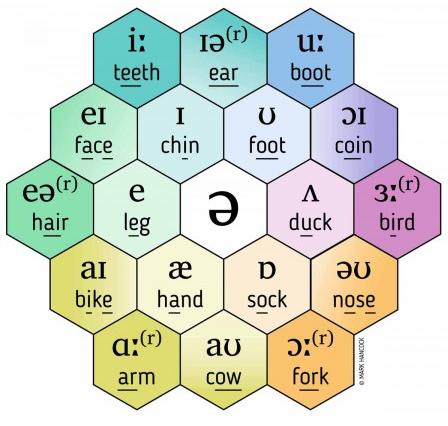
Many people worry about their English pronunciation. I always reassure students that, while pronunciation is obviously important, having an accent isn’t a problem. Everyone has some kind of accent, and few people manage to completely get rid of it, but a very strong accent can make it harder for people to understand you—and being understood is the main goal when learning a foreign language.
What is your goal accent?

People always say “I want to speak with an English accent!” but which one? Experts estimate that there are at least 60 distinct regional accents within the United Kingdom, not to mention the other native speaker accents in Ireland, the USA, Canada, South Africa, Australia and New Zealand.
In my experience there are two main ideas that people have when they say they want to speak like a native. They often are referring to Received Pronunciation, sometimes called BBC English or the Queen’s (or maybe now the King’s) English. This is the considered the prestige accent, associated with people who go to expensive schools and come from the upper classes, rather than being connected to a specific geographic area. Another advantage of RP is that it is one of the clearer British accents that can be more easily understood by people, and the phonetic spellings you’ll find in an English dictionary are done in RP. However, only around 2% of the population of the UK actually speak it (and it’s in decline as well) so it is hardly a ‘standard’ accent.
The other accent that people often aim for is General American (sometimes called Standard American). Like Received Pronunciation, it is an accent mostly unconnected from specific geographic regions and is considered a much clearer and more easily understood accent than many accents
Pick one person:
It’s impossible to sound like everyone, so pick one person. Is there one celebrity, one actor or singer, that you particularly like? Maybe one of your teachers has a voice that sounds good to you. Pick that one person and try and model your voice on theirs. Many students believe they can’t speak in a British accent but if I ask them to make fun of me or another British person they can do a pretty good impression! At first it will feel weird, but the more you do it, the less of an effort it will be and the more natural it will sound to you.
One student told me once that he dreamed of sounding like the actor Patrick Stewart who played Jean-Luc Picard in Star Trek and Professor X in the X-Men movies. He was shocked when I told him that the famous clear voice that Patrick Stewart speaks with isn’t his natural accent either! Stewart grew up in Huddersfield with a strong Yorkshire accent and only learnt to speak the way he speaks now when he went to drama school. An accent shift is possible, whether you’re using your native language or a foreign one.
Identify your problem sounds
People often have trouble with particular sounds. This is often due to what we call L1 interference. There are certain sounds that are familiar to you as they exist in your native language, however not every sound is shared by every language so the sounds which are less common or don’t exist in your first language are going to be harder to pronounce. For example, native Spanish speakers struggle with the difference between the short /i/ of ‘hit’ and the long /i:/ of ‘heat’, Japanese speakers struggle with the difference of /l/ and /r/ in words like ‘wrong’ and ‘long’, and Arabic speakers find the pronunciation of /p/ sounds tricky as their language only has a /b/.
Like with the idea of imitating, you have to put effort into identifying those sounds you find tricky and work on them individually. Try saying words that contain those sounds out loud and maybe even recording yourself to listen back. When you encounter a word with that sound in it slow down and be more deliberate in how you move your tongue in your mouth. At first it will feel like effort but as you do it more and more it will become natural.
Stress, Rhythm and Intonation
As well as the individual sounds, one of the things that makes English sound like English is the rhythm of the words and the sentences. It’s important to stress the correct syllable in a word, and it’s also important to stress the correct words in a sentence. Usually the key information words like nouns, verbs and adjectives are the ones which are stressed and connecting words like auxiliary verbs and prepositions are unstressed and pronounced weakly.
While English is not a tonal language as such, your intonation conveys information too. A rising intonation often sounds less sure and more like a question. A flat intonation sounds like you’re bored or uninterested. Rhythm and intonation are sometimes called ‘the music of English’ and it also makes you sound much more like a fluent speaker if you use them well.
Record yourself:
One advantage that all of us have nowadays compared to the past is that all of us carry a microphone and a recording device in our pockets at all times. Recording and playback is a fantastic tool in improving your pronunciation.
Choose a short piece of text. This can be from a book, a website or really anywhere. Record yourself reading it aloud.
Listen back to the recording (I know this feels embarrassing at first!) and focus on your pronunciation. Are there any words or sounds which don’t sound right? Does it. If you are aiming for a particular goal accent or to sound like one person then your text should be something that they have said or read aloud so you can compare them. If you want to sound like one of your teachers you could ask them to read the text first and record them.
Again, you start slowly and with deliberate effort, but through repetition it will become natural. It’s like riding a bike, at first you’re wobbly and unsure, and maybe you need training wheels or your father’s hand on your shoulder, but once you get moving it stops being something you think about and the words and sentences will flow naturally.
Don’t worry about the exact terminology:
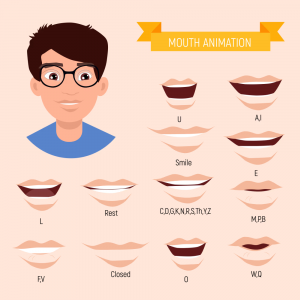
There are many technical terms connected to pronunciation and sounds but you really don’t need to know them. You don’t need to know what a labiodental fricative or a tone unit is, you just need the practical knowledge of how to speak and that comes from a simple process:
Pick a target: who do you want to sound like? Are you looking to completely get rid of your accent or just make yourself more understandable?
Identify your weaknesses: individual sounds, stress patterns or incorrect intonation.
Start slow: Take care and make a deliberate effort to pronounce correctly and clearly.
Gradually speed up: As you become more confident with the pronunciation you want you can start to speak more quickly and naturally.
Some useful terms to know:
Though you don’t need to know all the technical vocabulary, these are some useful terms to know connected to pronunciation.
Phoneme: a sound
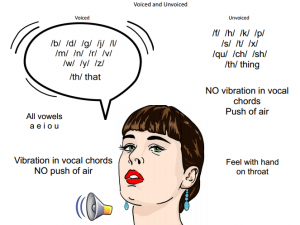
Voiced: a sound which uses the vibration of the vocal chords to make sound. For example /z/ as in ‘buzz’.
Unvoiced: a sound which uses the air passing through your mouth to make sound. For example /s/ as in ‘bus’. If you hold your fingers to the side of your throat and make a ‘zzzzzzzzzzz’ sound then an ‘ssssssssss’ sound you can feel the difference.
Syllable: the sounds in a word. For example, the word ‘strawberry’ has three syllables. Straw-ber-ry.
Stress (or emphasis): the part of the word or the sentence which you pronounce in a stronger way