
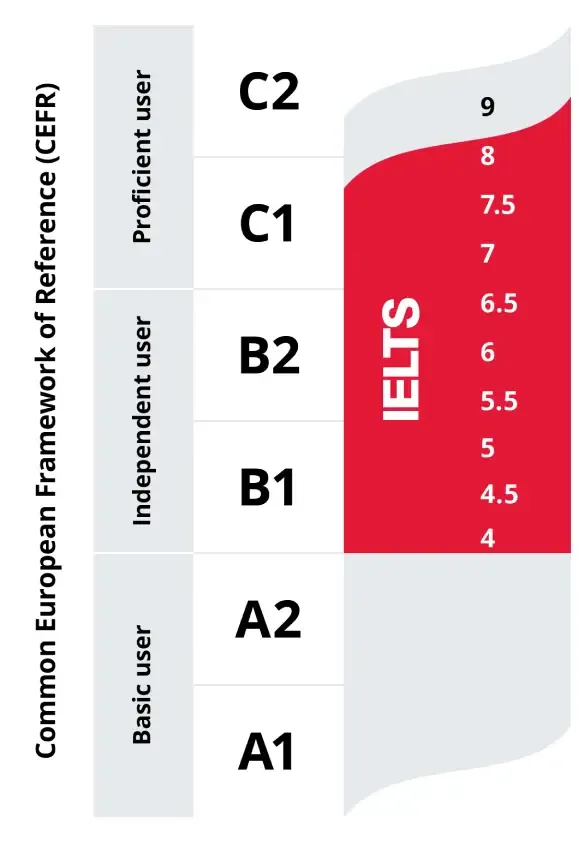
One of the most popular exams to take in English is the IELTS (International English Language Testing System). IELTS is primarily used for visas and getting a place in English speaking universities. There are other tests that you can take, (students planning to study at an American university often prefer the TOEFL, for example) but IELTS remains the most popular around the world. Over the years at Oxford School of English, we have helped hundreds of students prepare for their IELTS tests, and in this blog I’ll share a short overview of the test and a few general tips.
Two IELTS:
There are two types of IELTS test: the General English IELTS and the Academic English IELTS. If you’re taking the test for visa purposes the General is preferable but if you’re looking to study further in the UK in a subject of your choosing, the Academic IELTS is often essential. We have taught General English IELTS at Oxford School of English, but in our experience, the Academic IELTS is far more popular and desirable with students.
The speaking and listening sections of both tests are the same but the reading and writing sections are different.
In the General Training IELTS, the reading consists of everyday texts like magazines or advertisements, the kind of thing you might encounter in a normal job or while living in an English-speaking country. In the Academic IELTS, the reading is three academic articles.
In both tests the writing is two parts and the second part is the same, an essay on a given topic, but the first part of the test is different. In General, you have to write a letter for a specific scenario such as answering a complaint or giving information to a friend, in Academic the first part of the writing is writing a description of a diagram or a graph that you are given.
In this article I’ll be focusing on the Academic IELTS as it’s the exam most of our students are interested in, though we do have the capacity to teach General Training IELTS at Oxford School of English as well if anyone requires it.
How do I pass?
IELTS is a multi-level exam, which means there is no pass or fail boundary. Instead, students are aiming for a specific score which they need for their goals. The IELTS scale goes from 1-9. Different courses and different universities or institutions have different requirements but usually the requirements are something like:
Foundation course: 4.5-5.5
Undergraduate degree: 5.5-6.5
Masters degree: 6.5-7.5
Doctorate or DPhil: 7.5+
Of course, these are only rough guidelines. More prestigious organisations might ask for a higher score and degrees which require more engagement with complex language like humanities degrees might have different requirements from a STEM degree which has more practical coursework.
Also, many institutions ask for a minimum score for particular skills. So you might be required, for example, to get a 6.5 overall with a minimum 6 in the writing section. So if you scored Speaking 7.5, Reading 7, Listening 6.5, Writing 5.5 then they would not accept the score even though your average score is higher than 6.5.
It’s best to discuss with the institution that you want to go to what score they want you to achieve. That way you can have a clear goal when you come to our school.
We also suggest that students attain at least a B2 level of English before engaging in IELTS preparation. While it is occasionally possible to do IELTS at a B1 level if you only require a 4.5, the complexity of the texts used means that trying to prepare for IELTS too early can sometimes do more harm than good in regards to somebody’s English progress. Taking IELTS when you’re A2 is like trying to swim from England to France when you’ve never swam more than a 100m before. At Oxford School of English we either teach IELTS in small dedicated IELTS classes or in 1:1 lessons alongside our General English courses. This is what we have found benefits our students the most in achieving their desired IELTS score.
A bit about the structure of the exam:
One thing many students like about IELTS is that, unlike the Cambridge suite (FCE, CAE etc), it has no Use of English section which means there are no specific grammar exercises. The four sections are all practical skill usage.
Reading:
The Academic IELTS reading consists of three passages taken from academic articles. These passages could be from any subject: history, geography, biology, chemistry or anything else you can think of. They might be about anything in the world: disease control in Tsarist Russia, Vitamin C levels in Alaskan residents, the cultural significance of the Farfisa organ, the life of a honeybee. All of these subjects are things I have encountered in IELTS reading texts.
These texts are using native speaker level academic English, because they are designed to test people who are looking to get an 8 or 9 as well as people aiming for 4 or 5. There are forty questions. Each text has between 12 and 14 questions. There is no progression in difficulty, meaning every text is of an equal (very high) level of English, though the answers to some questions are much easier to find than others.
The test is forty questions and lasts one hour. You should spend twenty minutes on each text. You can highlight or mark the reading texts to help you find the answer but you must write the answers on a separate answer sheet within the time limit. Only answers written on the official answer sheet are counted.
The main techniques you need to master are skimming and scanning. It’s not useful or good time-management to read the entire text carefully. Skimming is when you read a text quickly to get a general idea of where the information is. Scanning is when you try and pick out specific information from the text.
How it’s marked:
This table explains how your score on the reading correlates to the band score
| Correct answers | Band score |
| 39-40 | 9 |
| 37-38 | 8.5 |
| 35-36 | 8 |
| 33-34 | 7.5 |
| 30-32 | 7 |
| 27-29 | 6.5 |
| 23-26 | 6 |
| 19-22 | 5.5 |
| 15-18 | 5 |
| 13-14 | 4.5 |
| 10-12 | 4 |
| Less than 10 | 3.5 and below |
In subsequent blogs, we will look at the reading section in more depth, including looking at the different types of questions used and the specific strategies that can be employed for each one.
Writing:
The writing test, like the reading, lasts one hour. It has two questions.
Part one:
In the first question, you will be asked to describe a diagram. This could be:
– a table
– a bar chart
– a line graph
– a pie chart
– some combination of between 2-4 of these four things
– a diagram
– a flow chart
– a map of a single place
– two maps of the same place at different times
For part one, you must write at least 150 words.
DO NOT ANALYSE! The most common mistake that people make in task one when first attempting it is that they think they should analyse and explain why the graph is the way it is. That is not what the question wants you to do. The way the question is phrased will always ask you
For example, look at this graph.
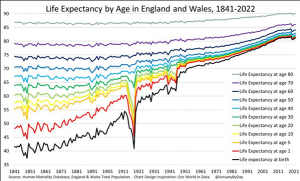
The general upwards trend of the graph is marked by large dips in the mid 1910s and 1940s. Anyone familiar with the history of the twentieth century would immediately tell you that this is due to the first and second world wars. However, if you were writing an IELTS task one question about this graph, that would count as analysis or bringing in outside knowledge so writing a sentence like “In the 1910s there was a dramatic fall in life expectancy due to the first world war” would actually lose you marks because you are not doing what the question asks you to do. They want you to describe, not speculate or analyse. This is the main general tip and in subsequent blogs we will explain how to answer IELTS questions in more detail.
Part two:
In the second task, you will be asked to write a short essay of 250 words. Like the reading, they could be on any topic, but they are usually on a social issue which you should have encountered. While they are all essay questions, they can be worded slightly differently. Some essay questions want you to look at the advantages and disadvantages of a particular issue, while some might ask you to look at problems in the world and suggest solutions. All of the writing part two questions will ask you to give examples and provide an opinion.
The basic structure of an IELTS essay will always be the same:
A short one paragraph introduction
Between two and four body paragraphs that analyse the issue, each paragraph should contain an explanation and at least one example
A concluding paragraph where you express your final opinion
How it’s marked:
In the IELTs you will lose marks if you do not write enough. There is no penalty for writing a lot more than the word limit, however you also do not get extra points for doing so. As it is a relatively short exam, it doesn’t make sense to try to write a lot if those extra words don’t contain things (like high-level vocabulary or more advanced grammatical structures) that will not get you any more points. A focused 250-word essay which makes a clear point in a logical way is far better than a rambling 400-word essay which might include more vocabulary but is less well-organised and does not make its points as clearly.
The IELTS writing is marked on four categories (each marked out of nine like the general IELTS scale and each given equal importance).
Task Achievement: How well have you answered the question? Have you done everything the question asked you to do?
Coherence and Cohesion: How well organised is your writing? Does it progress logically? Have you used appropriate linking words and phrases? Is each paragraph clearly separate from the others?
Lexical Resource: How good is your vocabulary usage? Have you used more advanced words? Have you used them correctly? Have you spelled them correctly?
Grammatical range and accuracy: Have you demonstrated your grammatical knowledge by using more advanced structures? Are your sentences correct grammatically?
We’ll get into more specifics about the writing and how you can improve your score in a later blog.
Listening
Like the reading, the listening section is forty questions so the same grade boundaries apply as in the earlier table. Unlike the reading, the listening exam does get progressively more difficult with each section. The thing which distinguishes the IELTS listening and makes it more difficult than other exams is that each listening is only played once, rather than twice as in the CAE exam. This means you must concentrate carefully for the entire exam. There are short breaks between each section to allow you to look at the questions for the next part and for the first three sections there is also a short break in the middle of the section.
The first part of the listening is an every day conversation between two people. Situations might include someone applying for a job, buying a plane ticket or booking a table at a restaurant.
In the second part, you will hear one person giving an informative talk. It might be a principal welcoming new students to a university, or a tour guide explaining a historical site. During this section there is always at least one question where you must label a map which is being described.
The third section of the listening is another conversation, but this time with a more academic focus. It could be between a teacher and a student, or between two or three students discussing a project or assignment they have to work on.
The fourth part of the listening is an extract from a lecture on an academic topic. Unlike sections 1-3, section four is played through in its entirety with no breaks.
The IELTS listening test takes around thirty-five to forty minutes, depending on the lengths of the listenings used. Like the reading, you must submit your answers on a separate answer sheet, however in the listening you are given an extra five minutes after the listening has concluded to transfer your answers onto this sheet.
Listening is the section which benefits most from repeated practice to get used to the format of the exam and the type of questions they’re going to ask you. There aren’t many specific strategies beyond improving your ability to concentrate and your general listening skills.
Speaking
The speaking is the shortest part of the IELTS exam. It usually takes between eleven and fourteen minutes. It consists of three sections.
Before the exam begins properly you’ll be asked to introduce yourself. Once the exams begins, the first section is more everyday discussion questions about familiar topics like your hometown, your hobbies, your family and things like that.
Part two:
In the second part you will be given a prompt like this:
Describe a place you went on holiday. You should talk about:
– where you went
– who you went with
– what your accommodation was like
and explain what made it such a memorable experience
After being given a minute to prepare during which time you can make notes you should start speaking. You have a very short time to make notes so don’t write full sentences, just a word or two for each point to help jog your memory if you get stuck. The examiners want you to speak for around two minutes. If you speak for less than one minute you will lose marks. If you go on for too long.
A good general rule for the IELTS part two speaking is that the first three points (which are all factual) should take around a minute to talk about in total, and the final explanatory point which includes more personal opinion should also take around a minute.
The examiner might ask you some short follow up questions about your story.
Here’s a top IELTS tip: YOU CAN ALWAYS LIE! You are not being marked on telling the truth, you are being marked on how well you know English. If the question asks you about your favourite book you must talk about it. You cannot say “I don’t read books” and leave it at that, you’ve got to talk about something. However, creating something new and also speaking in a different language than your mother tongue is a difficult thing to do so for those reasons I recommend sticking to the truth as much as possible but adding a little extra embellishment to you story in order to include some more advanced vocabulary which can impress the examiner is a fine. This applies to the examples in the writing as well. If you can’t think of a real example, make something up (though of course it should be plausible, like a political situation in your country, not a time when you got abducted by a UFO).
Part three:
The third part of the speaking is another conversational section however in contrast to the first part, the questions are more abstract and conceptual. Whereas in part one you’ll be asked about your family, in part three they might ask you about how a person’s family dynamics affect their perception of the world as an adult. Of course, you can use personal experiences as evidence or as a basis for what you want to say but the real focus is on understanding the more complex issue which is being asked about. Part three questions are usually on a connected topic to part two so if part two was, for example, about your favourite animal., part three might be about conservation, protecting endangered species and other such similar topics.
How it’s marked:
The speaking is marked on four categories:
Fluency and coherence: How well does what you say make sense. Do you pause too much? Some hesitation is natural and expected but a long pause will bring your mark down.
Lexical resource: Vocabulary. Both in terms of the range of vocabulary used and how accurately it is being used. Simple words like ‘good’ or ‘bad’ won’t score much but more descriptive or extreme adjectives like ‘fantastic’, ‘tremendous’ or ‘woeful’ will really get the examiner excited.
Grammatical resource: Like the vocabulary, range and accuracy are considered here. Attempting to use a complex structure like a second conditional sentence and making a small is much better than just using present and past simple even if they are used entirely correctly.
Pronunciation: How easy are you to understand? An accent will not lose you marks unless it is so strong that it makes you hard to understand.
That’s a basic overview of the IELTS exam. At Oxford School of English, we have thousands of hours of experience teaching IELTS students and an excellent record of helping hundreds and hundreds of IELTS students over the years achieve the score they need to further their personal goals in their career or education. We hope you’ll join us. Online practice is helpful, but nothing beats being immersed in English at an English language school getting expert feedback from teachers who have taught IELTS classes and other forms of English for many years.