
Why reading is so important:
Reading is the best way to expand your vocabulary. A large study by a team at the UCL Institute of Education found that teenagers who read often know, on average, 26% more words than their peers who read little or not at all. This applies to second-language learning as well.
Take your time:
One of the main benefits of reading is that you can go at your own speed, as fast or as slow as you want. Many students like to watch TV or films in English, and while this can be useful for improving listening skills, if you pause every time one of the characters uses a word that you’re not sure about in order to check a dictionary, you’re going to spoil your enjoyment of the story as well as probably annoying anyone you’re watching it with. With reading, you set the pace, when you encounter a new or unfamiliar word you have time to slow down and think about the word.
How to think about new words:

- Do I know this word? Have I encountered it before in a different form or context?
- What kind of word is it? A noun? A verb? An adjective?
- Does the context of the sentence help me understand what it means?
- Do parts of the word like prefixes give me a clue as to the meaning?
- Does it resemble a word I know in my language? (Be careful of false friends!)
Then you can check it using an English dictionary, a bilingual dictionary, or a translation app. Thinking about the word first before you check its meaning helps it stick in your mind. If you go straight to Google Translate then you’re less likely to remember it.
Keep a notebook for vocabulary with you to write down the new words you encounter. Then you can test yourself on them later.
Tips for getting the most out of your reading:
- Choose something you’re already interested in. So often students who don’t read much try and pick a book that they wouldn’t read if it was in their own language. This makes it much harder to concentrate on. If you like mysteries, read a mystery in English. If you like fashion, try buying an English fashion magazine. If you like football, read a game report on an English website. If you’re engaged with the topic already, staying focused is much easier. Use your existing passions to help boost your engagement with the English language.
- Pick a suitable text for your level. It’s a bad idea to try and jump straight in to a big English novel written for native speakers. It’s like trying to swim from England to France when you’ve only just learnt your front crawl. At our school we have a range of Graded Readers designed for specific levels which will challenge you and have unfamiliar vocabulary but won’t overwhelm you with hundreds of new words. There are also websites which have simplified versions of English. For example, Wikipedia has a Simple English version designed for people who are learning English. It has almost 300000 articles written in more basic vocabulary to help people improve their English. Whether you’re interested in history, sport, science or anything else. There is sure to be something that you will find fascinating. Which brings me to my next point:
- It doesn’t have to be books! Yes, books are fantastic, but many times students have told me that they don’t read at all, then at break time I see them scrolling social media or reading the news on their phone. That can be reading! Try changing the language on your phone to English, or going to an English language website for the news. Comic books, manga or graphic novels are also a great way to read, as the pictures will help you understand words that you’re not sure about.
- Read with others. A book club is a great way to improve your reading and also make friends. Discussing something that you’ve read helps reinforce the language and also improves your speaking and listening skills.
How we teach reading at the school:
In class, there are two specific reading skills that usually get focused on:
Reading for gist: this means understanding the main points of the text even if you’re not sure about every word used. This is important when you’re reading something quickly and want to understand the main idea or purpose of what you’re reading. This is what we usually look at the first time we look at a text.
Reading for detail: this means picking out specific pieces of information from the text. This is important when you need to find precise facts in a text. This is often the focus when you look more closely at a text after getting the general idea. This would include exercises like multiple choice questions, gap fills and identifying specific words or phrases.
Both these skills are extremely important both in everyday life and also if you’re planning on taking an English exam such as IELTS, FCE or CAE. Reading skills are incorporated into all of our General English lessons morning lessons. In the third lesson (which students who are on our General English 20 or General English 30 Intensive course attend), once or twice a week we also often do more extended reading practice, where students will read a longer text of their choice and at the end of the lesson share what they’ve learnt with the class.
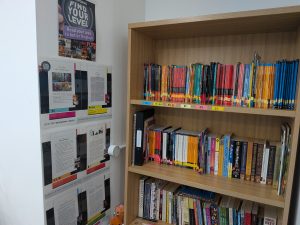
In our common room we have a range of books that students are welcome to borrow, including Graded Readers which are specifically written to be appropriate for different levels. Also, our teachers are ready and willing to recommend texts suitable for your level and interests.
Reading is both a fantastic way to expand your vocabulary so you sound more fluent and natural in English and also a great way to engage with the world in general and have fun.